The American Heart Association will be holding its annual meeting this November. Cardiobrief.org just posted the announced "late-breaking" clinical trials. These are the big name trials that usually grab a lot of headlines. One of the trials is the AIM-HIGH trial which showed that Niacian didn't really do much in patients whose bad cholesterol or LDL was controlled with a statin (see my post What to do about Niacin? )
Another very important study will also be presented that same November 15th, 2011: Comparison of the Progression of Coronary Atherosclerosis for Two High Efficacy Statin Regimens with Different HDL Effects: SATURN Study Results. The SATURN study is the Astra Zeneca (makers of Crestor) study comparing high dose Crestor (40mg) with high dose Lipitor (80mg).
Patients in the SATURN study will have known cardiac disease as indicated by a need for coronary angiography (angiogram) and angiographic evidence of coronary disease. The main end point is is IVUS-assessed change in the percent atheroma volume in a >40-mm segment of a single coronary artery; which is a "doctor" way of saying they are going to look for plaque build up in the artery. This is the same end point used in the famous (or infamous) ENHANCE trial which showed that adding Zetia to simvastatin (zetia + simvastatin = Vytorin) did absolutely nothing to plaque build up ( Vytorin and Zetia: What to do now? )
What's interesting about SATURN is that the LDL lowering properties of the highest doses of Crestor and Lipitor are about the same. However, at those doses Crestor raises the HDL or good cholesterol by about 8% where Lipitor only raises HDL by 3%. Other studies have shown that plaque build up in the arteries (atherosclerosis) that causes heart attacks and strokes, is not just about LDL, but also about HDL. Other studies looking at high doses of Crestor when compared to placebo show that it can prevent plaque build up and possibly even lead to regression. The Lipitor data on this is less robust.
The timing of the results at the AHA is particularly interesting, since it will coincide with Lipitor going generic. Zocor or simvastatin has been generic for a while, and works well in many patients. However, patients requiring more aggressive reduction in their cholesterol will not meet their goals on simvastatin and high dose simvastatin is associated with side effects, which prompted a recent FDA warning. (See Don't Take High Dose Simvastatin). Thus, the need for a generic potent statin like Lipitor is huge. However, this could mean that insurers will make it very, very difficult for patients to get Crestor. UNLESS......... SATURN proves that high dose Crestor compared to high dose Lipitor significant reduces plaque build up in high risk patients.
Therefore, the SATURN trial is really a huge gamble for Astra Zeneca. When Merck's ENHANCE trial showed that Vytorin didn't really do more than the generic statin, prescribing rates dropped precipitously. Crestor likely faces the same fate is SATURN turns out to be a negative study.
Showing posts with label simvastatin. Show all posts
Showing posts with label simvastatin. Show all posts
Tuesday, August 16, 2011


Wednesday, June 8, 2011
Don't Take High Dose Simvastatin!
Today the FDA just announced a new warning on the highest dose of simvastatin, the most popular cholesterol medication prescription in the country. They have issued this warning because "the highest approved dose--80 milligram (mg)--has been associated with an elevated risk of muscle injury or myopathy, particularly during the first 12 months of use."
The current recommendation is not to start simvastatin at 80mg and only to continue taking the 80mg if you "have been taking this dose for 12 months or more and have not experienced any muscle toxicity. It should not be prescribed to new patients.

In fact, simvastatin makes sense for many patients. Most data suggest that benefit is derived from statins when they reach about a 30% reduction in bad cholesterol, or LDL. The folks at the NIH's NHLBI have evaluated the efficacy of all the available statins (see below) and you can see that most statins will achieve that goal at various doses. For example 10mg of atorvastatin (Lipitor), 20-40mg of simvastatin, and 5mg of rosuvastatin (Crestor) all lower LDL cholesterol by about the same amount. Thus, if you just need a 30% reduction in LDL, you should be fine with the generic. Problem is that many patients need more than that amount of reduction. Thus, if you want to stick to a generic, you would have to go to 80mg of simvastatin.

Now one might thing that the stronger, more potent the statin, the more likely it is to cause side effects. Turns out the opposite is true. The graph below shows that when plotting LDL reduction against number of patients developing myopathy (what the FDA is concerned about), it seems like the more potent statins (Crestor, Lipitor) not only lower cholesterol better, but have a lower risk of myopathy. Myopathy is pretty uncommon, usually only about 1/10,000 or 0.01%. Looking at both Lipitor and Crestor, you can see as the dose goes up (10, 20, 40, 80) the percent of reduction of LDL continues to improve, but rate of myopathy is pretty much the same except for a slight bump at the 80mg dose of Lipitor. (Though not on the graph, you can see why the 80 mg dose of Crestor wasn't approved, because at that dose there was significant myopathy). However, when you jump from 40-80 mg of simvastatin, the LDL only goes up a few points, but the rate of myopathy skyrockets to over 1% (that's 1/100 instead of 1/10,000). Finally, you can why cerivastatin or Baycol was pulled from the market. It was pretty weak at lowering LDL, but had up to 2% incidence of myopathy at the higher doses.

The good news is that Lipitor will go generic in only a few months. When that happens, I am sure that the graph above will change drastically. All Lipitor scripts will likely go to the generic medication and probably many of the simvastatin prescriptions will also switch to generic atorvastin, since it is a better statin (more potent, fewer side effects). Crestor is another option (most effective, fewest side effects), but will not go generic for a while. The other thing to note is that Pfizer, who is about to lose Lipitor, is trying to get as much business as it can by offering patient coupons, so that (as long as you are not on Medicare part D or Medicaid) a prescription of Lipitor will only cost you $4 until it goes generic.
Bottom Line: All statins are not created equal and generic is not always best. If you are on Simvastatin 80mg, you should seriously discuss with your doctor about switching. In fact, if you are on simvastatin at any dose and not on Medicare part D or Medicaid, but have commercial insurance, you should consider asking your doctor about switching to Lipitor with the $4 coupon (you may actually save money by NOT taking the generic) until it too goes generic.
The current recommendation is not to start simvastatin at 80mg and only to continue taking the 80mg if you "have been taking this dose for 12 months or more and have not experienced any muscle toxicity. It should not be prescribed to new patients.
First, why is this announcement so important.
As Forbes' Matthew Herper points out in A Snapshot Of The Cholesterol Drug Market, though Lipitor is the biggest selling drug in terms of dollars, generic simvastatin is actually the most commonly prescribed cholesterol lowering medication. As you can see from the graph below (viewed much better on the Forbes site), once Zocor became available as generic simvastatin, it became the most popular statin written (blue line) whereas Lipitor (red line) prescriptions continue to tumble. Over time, insurance companies have made it more and more difficult to write for any branded statin by increasing co-pays for patients or increasing hurdles to get prescriptions approved.

In fact, simvastatin makes sense for many patients. Most data suggest that benefit is derived from statins when they reach about a 30% reduction in bad cholesterol, or LDL. The folks at the NIH's NHLBI have evaluated the efficacy of all the available statins (see below) and you can see that most statins will achieve that goal at various doses. For example 10mg of atorvastatin (Lipitor), 20-40mg of simvastatin, and 5mg of rosuvastatin (Crestor) all lower LDL cholesterol by about the same amount. Thus, if you just need a 30% reduction in LDL, you should be fine with the generic. Problem is that many patients need more than that amount of reduction. Thus, if you want to stick to a generic, you would have to go to 80mg of simvastatin.

Now one might thing that the stronger, more potent the statin, the more likely it is to cause side effects. Turns out the opposite is true. The graph below shows that when plotting LDL reduction against number of patients developing myopathy (what the FDA is concerned about), it seems like the more potent statins (Crestor, Lipitor) not only lower cholesterol better, but have a lower risk of myopathy. Myopathy is pretty uncommon, usually only about 1/10,000 or 0.01%. Looking at both Lipitor and Crestor, you can see as the dose goes up (10, 20, 40, 80) the percent of reduction of LDL continues to improve, but rate of myopathy is pretty much the same except for a slight bump at the 80mg dose of Lipitor. (Though not on the graph, you can see why the 80 mg dose of Crestor wasn't approved, because at that dose there was significant myopathy). However, when you jump from 40-80 mg of simvastatin, the LDL only goes up a few points, but the rate of myopathy skyrockets to over 1% (that's 1/100 instead of 1/10,000). Finally, you can why cerivastatin or Baycol was pulled from the market. It was pretty weak at lowering LDL, but had up to 2% incidence of myopathy at the higher doses.
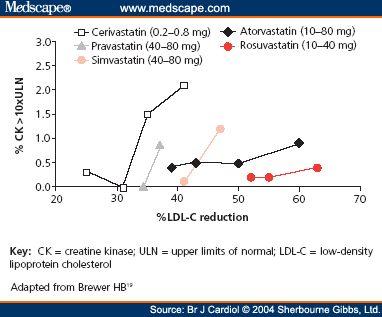
The good news is that Lipitor will go generic in only a few months. When that happens, I am sure that the graph above will change drastically. All Lipitor scripts will likely go to the generic medication and probably many of the simvastatin prescriptions will also switch to generic atorvastin, since it is a better statin (more potent, fewer side effects). Crestor is another option (most effective, fewest side effects), but will not go generic for a while. The other thing to note is that Pfizer, who is about to lose Lipitor, is trying to get as much business as it can by offering patient coupons, so that (as long as you are not on Medicare part D or Medicaid) a prescription of Lipitor will only cost you $4 until it goes generic.
Bottom Line: All statins are not created equal and generic is not always best. If you are on Simvastatin 80mg, you should seriously discuss with your doctor about switching. In fact, if you are on simvastatin at any dose and not on Medicare part D or Medicaid, but have commercial insurance, you should consider asking your doctor about switching to Lipitor with the $4 coupon (you may actually save money by NOT taking the generic) until it too goes generic.
Saturday, June 19, 2010
Boston Doctors Getting Paid to Switch Patients to Generics
Interesting video from WCVB in Boston about doctors getting kick backs from the insurance company to switch patients from branded medications to generic medications. New Rules To Protect Prescription Drug Customers
If people were concerned about undue influence when drug companies used to give physicians pens and other novelties (now currently banned by most companies), they should really be concerned about actually monetary payments. The patient interviewed in the Boston piece stated his doctor wanted to switch him from Lipitor to generic simvastatin (cholesterol lowering medications) but did not mention that he was being payed by his insurance company to do so.
Though this is the first case I have heard of doctors being incentivized to switch patients to generics, it happens in pharmacies all the time. What is horrible is that some pharmacies may switch patients to alternative medications even if that switch costs the patient more money. The example I am familiar with is albuterol inhalers (see FDA Announces End for CFC-Propelled Inhalers).
Switching to generics is itself not a bad things. I have blogged before that, for most medicines, generics are just as good as brand name medicines. For example, if the patient were on Zocor, a switch to the generic simvastatin would probably make a lot of sense, since the medications are basically equivalent and it would likely save the patient some money. However, in some cases, the small differences may actually make a difference. Back in November, I discussed this in more detail (see Generic and Therapeutic Substitutions ).
In this particular case, the therapeutic switch from Lipitor to simvastatin might have been devastating since Lipitor is a much stronger medication. The piece does not say what dose the patient was on, but if the patient required Lipitor 40mg or 80mg, no dose of simvastatin would have given him the cholesterol lowering he needed.
What should you do?
1. If you are on a branded medication, ask your doctor if there is a generic equivalent of the exact same medicine, or one that works just as well.
2. If you are on a branded medicine and asked to switch to a generic by your doctor, find out why he or she wants to switch.
3. If you are on a branded medicine and asked to switch to a generic by your pharmacy, find out why they want you to switch. Is your insurance company asking for the switch? Is the medicine the same (generic substitution) or slightly different (therapeutic substitution)? Regardless, make sure that you check with your doctor before switching any medicine.
If people were concerned about undue influence when drug companies used to give physicians pens and other novelties (now currently banned by most companies), they should really be concerned about actually monetary payments. The patient interviewed in the Boston piece stated his doctor wanted to switch him from Lipitor to generic simvastatin (cholesterol lowering medications) but did not mention that he was being payed by his insurance company to do so.
Though this is the first case I have heard of doctors being incentivized to switch patients to generics, it happens in pharmacies all the time. What is horrible is that some pharmacies may switch patients to alternative medications even if that switch costs the patient more money. The example I am familiar with is albuterol inhalers (see FDA Announces End for CFC-Propelled Inhalers).
Switching to generics is itself not a bad things. I have blogged before that, for most medicines, generics are just as good as brand name medicines. For example, if the patient were on Zocor, a switch to the generic simvastatin would probably make a lot of sense, since the medications are basically equivalent and it would likely save the patient some money. However, in some cases, the small differences may actually make a difference. Back in November, I discussed this in more detail (see Generic and Therapeutic Substitutions ).
In this particular case, the therapeutic switch from Lipitor to simvastatin might have been devastating since Lipitor is a much stronger medication. The piece does not say what dose the patient was on, but if the patient required Lipitor 40mg or 80mg, no dose of simvastatin would have given him the cholesterol lowering he needed.
What should you do?
1. If you are on a branded medication, ask your doctor if there is a generic equivalent of the exact same medicine, or one that works just as well.
2. If you are on a branded medicine and asked to switch to a generic by your doctor, find out why he or she wants to switch.
3. If you are on a branded medicine and asked to switch to a generic by your pharmacy, find out why they want you to switch. Is your insurance company asking for the switch? Is the medicine the same (generic substitution) or slightly different (therapeutic substitution)? Regardless, make sure that you check with your doctor before switching any medicine.
Monday, May 3, 2010
Are Drug Reps and Free Samples Bad For Patients? It Depends
One of my favorite blogs, KevinMD, featured a post by Internist and fellow blogger Dr. Leslie Ramirez (founder of Leslie’s List, which helps the uninsured and underinsured find more affordable medications and health care services) on the true cost of free drug samples. Her point was that "free" drug samples may cost a patient in the long run if they are followed up with an expensive prescription that the patient can't afford. I posted a response on Kevin's site (more below) stating the issue was a little more complex, as Dr. Ramirez' example applied specifically to a patient who was paying out of pocket for medications, which is not usually the case. However, this post received numerous responses about the value/evils of both drug reps and the samples they provide. Below is an edited/expanded version of my replies.
The Benefit and Harm of Reps and Samples
Do drug reps/free samples…
-influence doctors? Absolutely.
-increase prescribing of non-generic meds? Absolutely.
-contribute to health care dollars spent on meds? Absolutely.
-harm or are bad for patients? It depends.
It is true that whenever a generic medication has equal safety and efficacy as a branded medication, the patient and public benefit when a generic is used. However, just because there are generic medications available, does not always mean that generics are the best choice for patients.
A good example is type 2 diabetes. The RECORD (see For the RECORD, Avandia does not cause heart attacks) study looked at cardiovascular safety of the much maligned drug Avandia. (RECORD showed it not to increase risk of CV death or hospitalization-something the media continues to ignore). The study took patients on a generic diabetes medication (either metformin or sulfonylurea) and randomized them to either an expensive, branded diabetes medicine (Avandia) or the other generic. Patients in the Avandia group who still had uncontrolled diabetes on Avandia + one generic could add the other generic. Patients in the other group who were uncontrolled on both generics had to go to insulin.
In addition to showing no difference in cardiovascular safety (primary endpoint), the patients in the Avandia group had better diabetes control, less weight gain, better cholesterol profiles, less hypoglycemia and less insulin use. In other words, though it certainly costs more money, (in this study) it was better to add Avandia then sticking with only generics. This should not be surprising since we know that the older diabetes drugs fail after a few years, and that TZD's like Avandia (seen now in ADOPT, RECORD, and BARI 2D) sustain glycemic control.
There are a few other examples where generic products exist, but branded products may be better. Branded statins (Crestor, Lipitor) are likely better then generics for patients with high cardiovascular risk who need to get their LDL (bad) cholesterol down more than 40%. In hypertension, losartan is the first generic angiotensin receptor blocker (ARB). Though there are several ACE inhibitors that are good once a day generics (lisinopril), up to 10% of patients will get a cough and need to be switched to an ARB. Now we finally have a generic ARB, except this one is not nearly as good as the other 4 branded products on the market. Because insurance companies will likely make it very difficult (higher co-pays and prior authorizations) to get one of the branded ARB's, patients will likely need to get a cough on an ACE and then fail losartan, before they are allowed to use the newer, better ARBs (and will still have a very high co-pay).
In addition, there are many medications that have no generics. All the respiratory medications (Advair, Symbicort, Spiriva, etc.) essentially have no generic equivalent. Having a drug rep provide samples of these meds will (as stated above) certainly increase prescriptions and therefore increase healthcare spending. However, asthma kills about 11 patients a day, COPD is the 4th leading cause of death, and both conditions are substantially under treated. Writing more prescriptions of these medications, and thus the reps that provide them, should therfore be a good thing. Even if the medicines are costly, their increased use will prevent exacerbations, hospitalizations, and even death (which have their own costs).
There is also the issue of direct cost to the patient (out of pocket costs) and the convenience factor. The FDA just approved a combination pill of Nexium and Naprosyn for rheumatoid arthritis. Many patients with rheumatoid arthritis need to take NSAIDs like naproxen on a regular basis. One of the side effects is stomach ulcers. Acid blocking proton pump inhibitors (PPI's) like Nexium can prevent these ulcers and guidelines recommend the use of PPI's with chronic NSAID therapy. The newly approved, branded pill will be an expensive, once a day pill that will treat the arthritis and protect the stomach. However, Prilosec (another PPI) and Naprosyn, are both over the counter. Why not just take two over the counter pills a day instead of an expensive branded pill? CVS brand naproxen would cost about 10 cents for two 22omg pills (prescription dose is 500mg), and one Prilosec 20mg OTC (not as strong as Nexium, but should do) is about 70 cents a day. Thus, a patient needing NSAIDs and stomach protection would need to take 3 pills at 80 cents/day, or $24/month. However, it is very likely that the drug company will provide coupons for patients that guarantee them that their co-pay is no more than $25/month. I would think that most patients would prefer the better, once a day pill than the 3 pills a day for about the same price. (There is also a potential safety benefit as combining the pills ensures the stomach is protected when taking an NSAID).
As already alluded to, the issue becomes further complicated when insurance coverage, samples and coupons create complex equations where decision making becomes a challenge. One example would be high cholesterol. Let’s say your bad cholesterol or LDL is 160 and your doctor tells you it needs to be under 100 based on your risk for heart attack and stroke. Simivastatin is generic and has been proven effective, but you will likely need the highest dose of 80mg to get to your goal (the higher the dose, the greater the likelihood of side effects). Generic simvastatin (no samples) costs you $10 month at your local CVS. There is also Lipitor, a branded drug that will get you to goal at a 20mg dose, but at a price of $25 per month. However, I can give you a four week sample of Lipitor to try (to make sure there are not side effects, etc.) and a coupon that will lower your monthly cost to $15. This will last for a year (at which point Lipitor should be generic). Using the branded product with samples and coupons, the additional out of pocket cost to the patient is only $50/year or an extra $4/month, but they get to try the med first, and received a drug that worked better, with fewer side effects. Which is better for the patient? (Before you say that $50/year is a lot for a poor person, keep in mind that very poor patients are on Medicaid and won't pay any difference for the medications, and people who do not have prescription coverage might have problems being able to afford either, as generic simvastatin 80mg is $33/month).
To be fair, there are PLENTY of examples where branded drugs are promoted heavily by the industry using drug reps and samples, where an equally safe and effective medications are available generically. Dr. Ramirez' post regarding generic citalopram and Lexapro is a great example. In addition, the argument can be made that drug companies should be putting their resources coming up with useful new agents, rather than re-packaging older medicines into one pill (like Naprosyn and Nexium).
The point is that the issue of the samples, drug reps and the industry is a complex one. The drug industry is one of the most profitable industries in the US. Their use of expensive, direct to consumer advertising may seem inappropriate to some, when so many in our country can not afford medications. Past excesses of lavish gifts to physicians (no longer allowed) and more recent settlements of off label promotions (see Pharma Should Not Settle Off-Label Promotional Suits) has certainly eroded trust in the industry from the public, patients and many physicians.
However, drugs save lives. Even in recent years, we have seen the remarkable difference prescriptions medications have made (HIV, cancer, heart attacks). Also, the majority of prescriptions being used today are now generic, and were made possible because they were once sold under a brand name. As stated above, generics are not always the best choice for patients, and while drug company promotional efforts will undoubtedly increase sales of expensive drugs, this is not necessarily a bad thing if patients' lives are improved. Finally, the way medications are covered and paid for create a sometime perverse set of circumstances where samples and coupons for expensive medicines may actually be in the patient's best interest even if similar medications are available generically or over the counter. Many (especially in the media) want to paint the influence of the pharmaceutical industry as black and white. However, this issue remains very, very grey.
The Benefit and Harm of Reps and Samples
Do drug reps/free samples…
-influence doctors? Absolutely.
-increase prescribing of non-generic meds? Absolutely.
-contribute to health care dollars spent on meds? Absolutely.
-harm or are bad for patients? It depends.
It is true that whenever a generic medication has equal safety and efficacy as a branded medication, the patient and public benefit when a generic is used. However, just because there are generic medications available, does not always mean that generics are the best choice for patients.
A good example is type 2 diabetes. The RECORD (see For the RECORD, Avandia does not cause heart attacks) study looked at cardiovascular safety of the much maligned drug Avandia. (RECORD showed it not to increase risk of CV death or hospitalization-something the media continues to ignore). The study took patients on a generic diabetes medication (either metformin or sulfonylurea) and randomized them to either an expensive, branded diabetes medicine (Avandia) or the other generic. Patients in the Avandia group who still had uncontrolled diabetes on Avandia + one generic could add the other generic. Patients in the other group who were uncontrolled on both generics had to go to insulin.
In addition to showing no difference in cardiovascular safety (primary endpoint), the patients in the Avandia group had better diabetes control, less weight gain, better cholesterol profiles, less hypoglycemia and less insulin use. In other words, though it certainly costs more money, (in this study) it was better to add Avandia then sticking with only generics. This should not be surprising since we know that the older diabetes drugs fail after a few years, and that TZD's like Avandia (seen now in ADOPT, RECORD, and BARI 2D) sustain glycemic control.
There are a few other examples where generic products exist, but branded products may be better. Branded statins (Crestor, Lipitor) are likely better then generics for patients with high cardiovascular risk who need to get their LDL (bad) cholesterol down more than 40%. In hypertension, losartan is the first generic angiotensin receptor blocker (ARB). Though there are several ACE inhibitors that are good once a day generics (lisinopril), up to 10% of patients will get a cough and need to be switched to an ARB. Now we finally have a generic ARB, except this one is not nearly as good as the other 4 branded products on the market. Because insurance companies will likely make it very difficult (higher co-pays and prior authorizations) to get one of the branded ARB's, patients will likely need to get a cough on an ACE and then fail losartan, before they are allowed to use the newer, better ARBs (and will still have a very high co-pay).
In addition, there are many medications that have no generics. All the respiratory medications (Advair, Symbicort, Spiriva, etc.) essentially have no generic equivalent. Having a drug rep provide samples of these meds will (as stated above) certainly increase prescriptions and therefore increase healthcare spending. However, asthma kills about 11 patients a day, COPD is the 4th leading cause of death, and both conditions are substantially under treated. Writing more prescriptions of these medications, and thus the reps that provide them, should therfore be a good thing. Even if the medicines are costly, their increased use will prevent exacerbations, hospitalizations, and even death (which have their own costs).
There is also the issue of direct cost to the patient (out of pocket costs) and the convenience factor. The FDA just approved a combination pill of Nexium and Naprosyn for rheumatoid arthritis. Many patients with rheumatoid arthritis need to take NSAIDs like naproxen on a regular basis. One of the side effects is stomach ulcers. Acid blocking proton pump inhibitors (PPI's) like Nexium can prevent these ulcers and guidelines recommend the use of PPI's with chronic NSAID therapy. The newly approved, branded pill will be an expensive, once a day pill that will treat the arthritis and protect the stomach. However, Prilosec (another PPI) and Naprosyn, are both over the counter. Why not just take two over the counter pills a day instead of an expensive branded pill? CVS brand naproxen would cost about 10 cents for two 22omg pills (prescription dose is 500mg), and one Prilosec 20mg OTC (not as strong as Nexium, but should do) is about 70 cents a day. Thus, a patient needing NSAIDs and stomach protection would need to take 3 pills at 80 cents/day, or $24/month. However, it is very likely that the drug company will provide coupons for patients that guarantee them that their co-pay is no more than $25/month. I would think that most patients would prefer the better, once a day pill than the 3 pills a day for about the same price. (There is also a potential safety benefit as combining the pills ensures the stomach is protected when taking an NSAID).
As already alluded to, the issue becomes further complicated when insurance coverage, samples and coupons create complex equations where decision making becomes a challenge. One example would be high cholesterol. Let’s say your bad cholesterol or LDL is 160 and your doctor tells you it needs to be under 100 based on your risk for heart attack and stroke. Simivastatin is generic and has been proven effective, but you will likely need the highest dose of 80mg to get to your goal (the higher the dose, the greater the likelihood of side effects). Generic simvastatin (no samples) costs you $10 month at your local CVS. There is also Lipitor, a branded drug that will get you to goal at a 20mg dose, but at a price of $25 per month. However, I can give you a four week sample of Lipitor to try (to make sure there are not side effects, etc.) and a coupon that will lower your monthly cost to $15. This will last for a year (at which point Lipitor should be generic). Using the branded product with samples and coupons, the additional out of pocket cost to the patient is only $50/year or an extra $4/month, but they get to try the med first, and received a drug that worked better, with fewer side effects. Which is better for the patient? (Before you say that $50/year is a lot for a poor person, keep in mind that very poor patients are on Medicaid and won't pay any difference for the medications, and people who do not have prescription coverage might have problems being able to afford either, as generic simvastatin 80mg is $33/month).
To be fair, there are PLENTY of examples where branded drugs are promoted heavily by the industry using drug reps and samples, where an equally safe and effective medications are available generically. Dr. Ramirez' post regarding generic citalopram and Lexapro is a great example. In addition, the argument can be made that drug companies should be putting their resources coming up with useful new agents, rather than re-packaging older medicines into one pill (like Naprosyn and Nexium).
The point is that the issue of the samples, drug reps and the industry is a complex one. The drug industry is one of the most profitable industries in the US. Their use of expensive, direct to consumer advertising may seem inappropriate to some, when so many in our country can not afford medications. Past excesses of lavish gifts to physicians (no longer allowed) and more recent settlements of off label promotions (see Pharma Should Not Settle Off-Label Promotional Suits) has certainly eroded trust in the industry from the public, patients and many physicians.
However, drugs save lives. Even in recent years, we have seen the remarkable difference prescriptions medications have made (HIV, cancer, heart attacks). Also, the majority of prescriptions being used today are now generic, and were made possible because they were once sold under a brand name. As stated above, generics are not always the best choice for patients, and while drug company promotional efforts will undoubtedly increase sales of expensive drugs, this is not necessarily a bad thing if patients' lives are improved. Finally, the way medications are covered and paid for create a sometime perverse set of circumstances where samples and coupons for expensive medicines may actually be in the patient's best interest even if similar medications are available generically or over the counter. Many (especially in the media) want to paint the influence of the pharmaceutical industry as black and white. However, this issue remains very, very grey.
Subscribe to:
Posts (Atom)


