In my recent post All in for Crestor, I discussed how the SATURN study comparing Crestor to Lipitor was likely a make or break study for AstraZenca's cholesterol pill. As mentioned, because Lipitor will soon go generic in November, AZ needed to give insurance companies a reason to pay for the more expensive branded pill, then the soon to be generic and cheaper version of Lipitor, which has been the number one selling drug in the country.
As reported in Pharmalot's post Disappointing Crestor Results For AstraZeneca (see the official AstraZeneca statement here ), the just released results of SATURN show that the 40mg dose of Crestor was numerically but not statistically significantly better and reducing plaque build up (as measured by % change) as the 80mg dose of Lipitor. As secondary measure, plaque buildup as measured by volume was statistically significant, but since this was not the primary outcome of the study, it is likely enough for insurers to give Crestor a favorable status on their formulary lists.
Bottom Line: Crestor is a great drug. It reduces LDL better than Lipitor. We know that from outcome studies of all statins, that the lower the LDL with a statin, the more you decrease heart attacks and strokes. In addition, despite it's potency, it has very good tolerability. Certain patients that might need 80mg of Lipitor, might not be able to tolerate side effects at that high of a dose, and might end up doing better on 20mg or 40mg of Crestor. That said, starting in 2012, unless AZ cuts the price on Crestor drastically, it may be a challenge to get the prescription approved for patients.
Showing posts with label lipitor. Show all posts
Showing posts with label lipitor. Show all posts
Friday, September 2, 2011


Tuesday, August 16, 2011
All In For Crestor
The American Heart Association will be holding its annual meeting this November. Cardiobrief.org just posted the announced "late-breaking" clinical trials. These are the big name trials that usually grab a lot of headlines. One of the trials is the AIM-HIGH trial which showed that Niacian didn't really do much in patients whose bad cholesterol or LDL was controlled with a statin (see my post What to do about Niacin? )
Another very important study will also be presented that same November 15th, 2011: Comparison of the Progression of Coronary Atherosclerosis for Two High Efficacy Statin Regimens with Different HDL Effects: SATURN Study Results. The SATURN study is the Astra Zeneca (makers of Crestor) study comparing high dose Crestor (40mg) with high dose Lipitor (80mg).
Patients in the SATURN study will have known cardiac disease as indicated by a need for coronary angiography (angiogram) and angiographic evidence of coronary disease. The main end point is is IVUS-assessed change in the percent atheroma volume in a >40-mm segment of a single coronary artery; which is a "doctor" way of saying they are going to look for plaque build up in the artery. This is the same end point used in the famous (or infamous) ENHANCE trial which showed that adding Zetia to simvastatin (zetia + simvastatin = Vytorin) did absolutely nothing to plaque build up ( Vytorin and Zetia: What to do now? )
What's interesting about SATURN is that the LDL lowering properties of the highest doses of Crestor and Lipitor are about the same. However, at those doses Crestor raises the HDL or good cholesterol by about 8% where Lipitor only raises HDL by 3%. Other studies have shown that plaque build up in the arteries (atherosclerosis) that causes heart attacks and strokes, is not just about LDL, but also about HDL. Other studies looking at high doses of Crestor when compared to placebo show that it can prevent plaque build up and possibly even lead to regression. The Lipitor data on this is less robust.
The timing of the results at the AHA is particularly interesting, since it will coincide with Lipitor going generic. Zocor or simvastatin has been generic for a while, and works well in many patients. However, patients requiring more aggressive reduction in their cholesterol will not meet their goals on simvastatin and high dose simvastatin is associated with side effects, which prompted a recent FDA warning. (See Don't Take High Dose Simvastatin). Thus, the need for a generic potent statin like Lipitor is huge. However, this could mean that insurers will make it very, very difficult for patients to get Crestor. UNLESS......... SATURN proves that high dose Crestor compared to high dose Lipitor significant reduces plaque build up in high risk patients.
Therefore, the SATURN trial is really a huge gamble for Astra Zeneca. When Merck's ENHANCE trial showed that Vytorin didn't really do more than the generic statin, prescribing rates dropped precipitously. Crestor likely faces the same fate is SATURN turns out to be a negative study.
Thursday, August 4, 2011
Why OTC Lipitor is a Bad Idea
As reported by the Wall Street Journal, Pfizer, the maker of one the best selling drugs ever, is trying to get the FDA to approve an Over the Counter (OTC) version of their blockbuster Lipitor, not coincidentally on the eve of Lipitor going generic.
Readers of this blog know that I am a big proponent of cholesterol lowering medications like Lipitor (statins) for patients at moderate to high risk of cardiovascular disease. In particular, I am a fan of the more potent statins like Lipitor and Crestor, because of their increased efficacy with fewer side effects (see Don't Take High Dose Simvastatin). Finally having a generic version available of Lipitor will be a great thing for many patients.
That said, making Lipitor OTC is a bad move. First, there is a difference between medications like Prilosec and Claritin that have gone over the counter and Lipitor. Diagnosis for GERD and allergic rhinitis for which those medications respectively treat are made mostly on symptoms alone. Patients don't need to go to medical school to suspect that they may suffer from heart burn or allergies. Starting treatment without seeing a physician is actually medically sound because more often then not the medications will relieve symptoms avoiding a physician office visit. In contrast, starting a patient on a statin is much more tricky. Patients need to know their individual risk for cardiovascular disease. Though there are tools available online to determine this (I use the NIH's risk calculator daily in my clinic), determining individual risk of disease, benefit of taking a medication and weighing this against potential side effects is best decided by a discussion between a doctor and patient. Secondly, before starting a statin medication, one needs to know their cholesterol levels. Though there are other methods (health fairs, work screenings) of determining cholesterol levels, getting a blood test usually requires a visit to the doctor's office. In addition, follow up blood work (checking for medication efficacy, liver side effects) is warranted after starting treatment. Thus, the benefit of having a medication OTC is negated. Finally, Claritin and Prilosec are very safe. They are as safe or safer then other OTC medications. Lipitor is also very safe, but is associated with rare, but serious side effects. Taking Lipitor OTC without consultation with a physician creates the risks of patients developing these side effects without proper warnings and therefore potentially worse outcomes if attention is not sought.
The second main reason that OTC Lipitor is a bad idea is that it will hurt more patients than it will help. The reason for this is that when a medication goes OTC, insurance companies usually will not pay for them. Now that Allegra is over the counter, it is virtually impossible for any of my patients to get a prescription version antihistamine. Though they can easily get this OTC, not having a prescription means they need to pay for it out of pocket. The cost of an OTC medication, even if the generic OTC version is used, is generally more than the co-pay for a generic prescription. It is unlikely that generic Lipitor will make the $4 Walmart or Target list, but after six month, the co-pay for generic Lipitor would still likely cost a lot less for most patients then paying for OTC Lipitor out-of-pocket.
Bottom Line: The reason why Pfizer wants Lipitor OTC is for one reason: to make more money. They can argue that cardiovascular disease is the number one killer in the US, and by having Lipitor OTC, it will be available to more patients. However, because statins require blood work and medical consultations, the risk of harm to patients outweighs the potential benefits of greater availability. In addition, this will result in cost-shifting to patients in order to boost Pfizer's profits. Hopefully, the FDA will say what they said when Merk tried to pull this off: "No."
Wednesday, June 8, 2011
Don't Take High Dose Simvastatin!
Today the FDA just announced a new warning on the highest dose of simvastatin, the most popular cholesterol medication prescription in the country. They have issued this warning because "the highest approved dose--80 milligram (mg)--has been associated with an elevated risk of muscle injury or myopathy, particularly during the first 12 months of use."
The current recommendation is not to start simvastatin at 80mg and only to continue taking the 80mg if you "have been taking this dose for 12 months or more and have not experienced any muscle toxicity. It should not be prescribed to new patients.

In fact, simvastatin makes sense for many patients. Most data suggest that benefit is derived from statins when they reach about a 30% reduction in bad cholesterol, or LDL. The folks at the NIH's NHLBI have evaluated the efficacy of all the available statins (see below) and you can see that most statins will achieve that goal at various doses. For example 10mg of atorvastatin (Lipitor), 20-40mg of simvastatin, and 5mg of rosuvastatin (Crestor) all lower LDL cholesterol by about the same amount. Thus, if you just need a 30% reduction in LDL, you should be fine with the generic. Problem is that many patients need more than that amount of reduction. Thus, if you want to stick to a generic, you would have to go to 80mg of simvastatin.

Now one might thing that the stronger, more potent the statin, the more likely it is to cause side effects. Turns out the opposite is true. The graph below shows that when plotting LDL reduction against number of patients developing myopathy (what the FDA is concerned about), it seems like the more potent statins (Crestor, Lipitor) not only lower cholesterol better, but have a lower risk of myopathy. Myopathy is pretty uncommon, usually only about 1/10,000 or 0.01%. Looking at both Lipitor and Crestor, you can see as the dose goes up (10, 20, 40, 80) the percent of reduction of LDL continues to improve, but rate of myopathy is pretty much the same except for a slight bump at the 80mg dose of Lipitor. (Though not on the graph, you can see why the 80 mg dose of Crestor wasn't approved, because at that dose there was significant myopathy). However, when you jump from 40-80 mg of simvastatin, the LDL only goes up a few points, but the rate of myopathy skyrockets to over 1% (that's 1/100 instead of 1/10,000). Finally, you can why cerivastatin or Baycol was pulled from the market. It was pretty weak at lowering LDL, but had up to 2% incidence of myopathy at the higher doses.

The good news is that Lipitor will go generic in only a few months. When that happens, I am sure that the graph above will change drastically. All Lipitor scripts will likely go to the generic medication and probably many of the simvastatin prescriptions will also switch to generic atorvastin, since it is a better statin (more potent, fewer side effects). Crestor is another option (most effective, fewest side effects), but will not go generic for a while. The other thing to note is that Pfizer, who is about to lose Lipitor, is trying to get as much business as it can by offering patient coupons, so that (as long as you are not on Medicare part D or Medicaid) a prescription of Lipitor will only cost you $4 until it goes generic.
Bottom Line: All statins are not created equal and generic is not always best. If you are on Simvastatin 80mg, you should seriously discuss with your doctor about switching. In fact, if you are on simvastatin at any dose and not on Medicare part D or Medicaid, but have commercial insurance, you should consider asking your doctor about switching to Lipitor with the $4 coupon (you may actually save money by NOT taking the generic) until it too goes generic.
The current recommendation is not to start simvastatin at 80mg and only to continue taking the 80mg if you "have been taking this dose for 12 months or more and have not experienced any muscle toxicity. It should not be prescribed to new patients.
First, why is this announcement so important.
As Forbes' Matthew Herper points out in A Snapshot Of The Cholesterol Drug Market, though Lipitor is the biggest selling drug in terms of dollars, generic simvastatin is actually the most commonly prescribed cholesterol lowering medication. As you can see from the graph below (viewed much better on the Forbes site), once Zocor became available as generic simvastatin, it became the most popular statin written (blue line) whereas Lipitor (red line) prescriptions continue to tumble. Over time, insurance companies have made it more and more difficult to write for any branded statin by increasing co-pays for patients or increasing hurdles to get prescriptions approved.

In fact, simvastatin makes sense for many patients. Most data suggest that benefit is derived from statins when they reach about a 30% reduction in bad cholesterol, or LDL. The folks at the NIH's NHLBI have evaluated the efficacy of all the available statins (see below) and you can see that most statins will achieve that goal at various doses. For example 10mg of atorvastatin (Lipitor), 20-40mg of simvastatin, and 5mg of rosuvastatin (Crestor) all lower LDL cholesterol by about the same amount. Thus, if you just need a 30% reduction in LDL, you should be fine with the generic. Problem is that many patients need more than that amount of reduction. Thus, if you want to stick to a generic, you would have to go to 80mg of simvastatin.

Now one might thing that the stronger, more potent the statin, the more likely it is to cause side effects. Turns out the opposite is true. The graph below shows that when plotting LDL reduction against number of patients developing myopathy (what the FDA is concerned about), it seems like the more potent statins (Crestor, Lipitor) not only lower cholesterol better, but have a lower risk of myopathy. Myopathy is pretty uncommon, usually only about 1/10,000 or 0.01%. Looking at both Lipitor and Crestor, you can see as the dose goes up (10, 20, 40, 80) the percent of reduction of LDL continues to improve, but rate of myopathy is pretty much the same except for a slight bump at the 80mg dose of Lipitor. (Though not on the graph, you can see why the 80 mg dose of Crestor wasn't approved, because at that dose there was significant myopathy). However, when you jump from 40-80 mg of simvastatin, the LDL only goes up a few points, but the rate of myopathy skyrockets to over 1% (that's 1/100 instead of 1/10,000). Finally, you can why cerivastatin or Baycol was pulled from the market. It was pretty weak at lowering LDL, but had up to 2% incidence of myopathy at the higher doses.
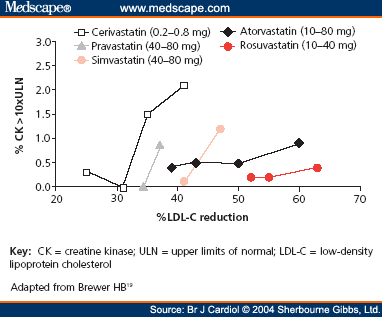
The good news is that Lipitor will go generic in only a few months. When that happens, I am sure that the graph above will change drastically. All Lipitor scripts will likely go to the generic medication and probably many of the simvastatin prescriptions will also switch to generic atorvastin, since it is a better statin (more potent, fewer side effects). Crestor is another option (most effective, fewest side effects), but will not go generic for a while. The other thing to note is that Pfizer, who is about to lose Lipitor, is trying to get as much business as it can by offering patient coupons, so that (as long as you are not on Medicare part D or Medicaid) a prescription of Lipitor will only cost you $4 until it goes generic.
Bottom Line: All statins are not created equal and generic is not always best. If you are on Simvastatin 80mg, you should seriously discuss with your doctor about switching. In fact, if you are on simvastatin at any dose and not on Medicare part D or Medicaid, but have commercial insurance, you should consider asking your doctor about switching to Lipitor with the $4 coupon (you may actually save money by NOT taking the generic) until it too goes generic.
Saturday, June 19, 2010
Boston Doctors Getting Paid to Switch Patients to Generics
Interesting video from WCVB in Boston about doctors getting kick backs from the insurance company to switch patients from branded medications to generic medications. New Rules To Protect Prescription Drug Customers
If people were concerned about undue influence when drug companies used to give physicians pens and other novelties (now currently banned by most companies), they should really be concerned about actually monetary payments. The patient interviewed in the Boston piece stated his doctor wanted to switch him from Lipitor to generic simvastatin (cholesterol lowering medications) but did not mention that he was being payed by his insurance company to do so.
Though this is the first case I have heard of doctors being incentivized to switch patients to generics, it happens in pharmacies all the time. What is horrible is that some pharmacies may switch patients to alternative medications even if that switch costs the patient more money. The example I am familiar with is albuterol inhalers (see FDA Announces End for CFC-Propelled Inhalers).
Switching to generics is itself not a bad things. I have blogged before that, for most medicines, generics are just as good as brand name medicines. For example, if the patient were on Zocor, a switch to the generic simvastatin would probably make a lot of sense, since the medications are basically equivalent and it would likely save the patient some money. However, in some cases, the small differences may actually make a difference. Back in November, I discussed this in more detail (see Generic and Therapeutic Substitutions ).
In this particular case, the therapeutic switch from Lipitor to simvastatin might have been devastating since Lipitor is a much stronger medication. The piece does not say what dose the patient was on, but if the patient required Lipitor 40mg or 80mg, no dose of simvastatin would have given him the cholesterol lowering he needed.
What should you do?
1. If you are on a branded medication, ask your doctor if there is a generic equivalent of the exact same medicine, or one that works just as well.
2. If you are on a branded medicine and asked to switch to a generic by your doctor, find out why he or she wants to switch.
3. If you are on a branded medicine and asked to switch to a generic by your pharmacy, find out why they want you to switch. Is your insurance company asking for the switch? Is the medicine the same (generic substitution) or slightly different (therapeutic substitution)? Regardless, make sure that you check with your doctor before switching any medicine.
Friday, May 14, 2010
Lipitor or Crestor for LDL's above 160
I just read A systematic review and meta-analysis on the therapeutic equivalence of statins. This artilce will not make any major U.S. headlines because it is a Taiwanese study from a not very well known journal. However, the methodology is sound and makes an important point to patients who need a statin and are deciding between a generic and more expensive brand name medication.
The study did a systematic review of all the studies which compared the different statins. They found that at comparable doses, statins are therapeutically equivalent in reducing LDL (or bad cholesterol). This would suggest that if statins are essentially equal, provided you use the right dose, then you should always go with a generic. However, the other thing they found was that "the only two statins that could reduce LDL-C more than 40% were rosuvastatin and atorvastatin at a daily dose of 20 mg or higher." In other words, those patients who need cholesterol lowering drugs and have to get their cholesterol down by less than 40% should be OK with generic, but those who need to get their LDL cholesterol by more than 40% should use either Crestor (rosuvastatin) or Lipitor (atorvastain). Though new guidelines should be out by the end of the year, current guidelines suggest that patients with increased risk for heart attack and stroke (all diabetics, mulitple risk factors,etc.), who are generally the patients we use statins in, need their LDL's under 100. This means that if you are at increased risk for heart attack and stroke, and your LDL is 160 or above, you should not take the generic (even if it is cheaper), but take the more expensive branded cholesterol medicines.
Fortunately, as I mentioned in a recent post Are Drug Reps and Free Samples Bad For Patients? It Depends, both companies offer coupons to offset the additional out of pocket costs, so you should not pay much more for Crestor or Lipitor than what you would pay for a generic medication.
Monday, May 3, 2010
Are Drug Reps and Free Samples Bad For Patients? It Depends
One of my favorite blogs, KevinMD, featured a post by Internist and fellow blogger Dr. Leslie Ramirez (founder of Leslie’s List, which helps the uninsured and underinsured find more affordable medications and health care services) on the true cost of free drug samples. Her point was that "free" drug samples may cost a patient in the long run if they are followed up with an expensive prescription that the patient can't afford. I posted a response on Kevin's site (more below) stating the issue was a little more complex, as Dr. Ramirez' example applied specifically to a patient who was paying out of pocket for medications, which is not usually the case. However, this post received numerous responses about the value/evils of both drug reps and the samples they provide. Below is an edited/expanded version of my replies.
The Benefit and Harm of Reps and Samples
Do drug reps/free samples…
-influence doctors? Absolutely.
-increase prescribing of non-generic meds? Absolutely.
-contribute to health care dollars spent on meds? Absolutely.
-harm or are bad for patients? It depends.
It is true that whenever a generic medication has equal safety and efficacy as a branded medication, the patient and public benefit when a generic is used. However, just because there are generic medications available, does not always mean that generics are the best choice for patients.
A good example is type 2 diabetes. The RECORD (see For the RECORD, Avandia does not cause heart attacks) study looked at cardiovascular safety of the much maligned drug Avandia. (RECORD showed it not to increase risk of CV death or hospitalization-something the media continues to ignore). The study took patients on a generic diabetes medication (either metformin or sulfonylurea) and randomized them to either an expensive, branded diabetes medicine (Avandia) or the other generic. Patients in the Avandia group who still had uncontrolled diabetes on Avandia + one generic could add the other generic. Patients in the other group who were uncontrolled on both generics had to go to insulin.
In addition to showing no difference in cardiovascular safety (primary endpoint), the patients in the Avandia group had better diabetes control, less weight gain, better cholesterol profiles, less hypoglycemia and less insulin use. In other words, though it certainly costs more money, (in this study) it was better to add Avandia then sticking with only generics. This should not be surprising since we know that the older diabetes drugs fail after a few years, and that TZD's like Avandia (seen now in ADOPT, RECORD, and BARI 2D) sustain glycemic control.
There are a few other examples where generic products exist, but branded products may be better. Branded statins (Crestor, Lipitor) are likely better then generics for patients with high cardiovascular risk who need to get their LDL (bad) cholesterol down more than 40%. In hypertension, losartan is the first generic angiotensin receptor blocker (ARB). Though there are several ACE inhibitors that are good once a day generics (lisinopril), up to 10% of patients will get a cough and need to be switched to an ARB. Now we finally have a generic ARB, except this one is not nearly as good as the other 4 branded products on the market. Because insurance companies will likely make it very difficult (higher co-pays and prior authorizations) to get one of the branded ARB's, patients will likely need to get a cough on an ACE and then fail losartan, before they are allowed to use the newer, better ARBs (and will still have a very high co-pay).
In addition, there are many medications that have no generics. All the respiratory medications (Advair, Symbicort, Spiriva, etc.) essentially have no generic equivalent. Having a drug rep provide samples of these meds will (as stated above) certainly increase prescriptions and therefore increase healthcare spending. However, asthma kills about 11 patients a day, COPD is the 4th leading cause of death, and both conditions are substantially under treated. Writing more prescriptions of these medications, and thus the reps that provide them, should therfore be a good thing. Even if the medicines are costly, their increased use will prevent exacerbations, hospitalizations, and even death (which have their own costs).
There is also the issue of direct cost to the patient (out of pocket costs) and the convenience factor. The FDA just approved a combination pill of Nexium and Naprosyn for rheumatoid arthritis. Many patients with rheumatoid arthritis need to take NSAIDs like naproxen on a regular basis. One of the side effects is stomach ulcers. Acid blocking proton pump inhibitors (PPI's) like Nexium can prevent these ulcers and guidelines recommend the use of PPI's with chronic NSAID therapy. The newly approved, branded pill will be an expensive, once a day pill that will treat the arthritis and protect the stomach. However, Prilosec (another PPI) and Naprosyn, are both over the counter. Why not just take two over the counter pills a day instead of an expensive branded pill? CVS brand naproxen would cost about 10 cents for two 22omg pills (prescription dose is 500mg), and one Prilosec 20mg OTC (not as strong as Nexium, but should do) is about 70 cents a day. Thus, a patient needing NSAIDs and stomach protection would need to take 3 pills at 80 cents/day, or $24/month. However, it is very likely that the drug company will provide coupons for patients that guarantee them that their co-pay is no more than $25/month. I would think that most patients would prefer the better, once a day pill than the 3 pills a day for about the same price. (There is also a potential safety benefit as combining the pills ensures the stomach is protected when taking an NSAID).
As already alluded to, the issue becomes further complicated when insurance coverage, samples and coupons create complex equations where decision making becomes a challenge. One example would be high cholesterol. Let’s say your bad cholesterol or LDL is 160 and your doctor tells you it needs to be under 100 based on your risk for heart attack and stroke. Simivastatin is generic and has been proven effective, but you will likely need the highest dose of 80mg to get to your goal (the higher the dose, the greater the likelihood of side effects). Generic simvastatin (no samples) costs you $10 month at your local CVS. There is also Lipitor, a branded drug that will get you to goal at a 20mg dose, but at a price of $25 per month. However, I can give you a four week sample of Lipitor to try (to make sure there are not side effects, etc.) and a coupon that will lower your monthly cost to $15. This will last for a year (at which point Lipitor should be generic). Using the branded product with samples and coupons, the additional out of pocket cost to the patient is only $50/year or an extra $4/month, but they get to try the med first, and received a drug that worked better, with fewer side effects. Which is better for the patient? (Before you say that $50/year is a lot for a poor person, keep in mind that very poor patients are on Medicaid and won't pay any difference for the medications, and people who do not have prescription coverage might have problems being able to afford either, as generic simvastatin 80mg is $33/month).
To be fair, there are PLENTY of examples where branded drugs are promoted heavily by the industry using drug reps and samples, where an equally safe and effective medications are available generically. Dr. Ramirez' post regarding generic citalopram and Lexapro is a great example. In addition, the argument can be made that drug companies should be putting their resources coming up with useful new agents, rather than re-packaging older medicines into one pill (like Naprosyn and Nexium).
The point is that the issue of the samples, drug reps and the industry is a complex one. The drug industry is one of the most profitable industries in the US. Their use of expensive, direct to consumer advertising may seem inappropriate to some, when so many in our country can not afford medications. Past excesses of lavish gifts to physicians (no longer allowed) and more recent settlements of off label promotions (see Pharma Should Not Settle Off-Label Promotional Suits) has certainly eroded trust in the industry from the public, patients and many physicians.
However, drugs save lives. Even in recent years, we have seen the remarkable difference prescriptions medications have made (HIV, cancer, heart attacks). Also, the majority of prescriptions being used today are now generic, and were made possible because they were once sold under a brand name. As stated above, generics are not always the best choice for patients, and while drug company promotional efforts will undoubtedly increase sales of expensive drugs, this is not necessarily a bad thing if patients' lives are improved. Finally, the way medications are covered and paid for create a sometime perverse set of circumstances where samples and coupons for expensive medicines may actually be in the patient's best interest even if similar medications are available generically or over the counter. Many (especially in the media) want to paint the influence of the pharmaceutical industry as black and white. However, this issue remains very, very grey.
Wednesday, February 17, 2010
Statins Don't Cause Diabetes
As of this morning, the only major source reporting the results of a recent study from Lancet is Business Week. However, the headlines that will likely pop up in the next few hours will likely be similar to theirs: "Cholesterol-Cutting Drugs Raise Diabetes Risk by 9% in Study." In my last post I discussed how the media likes bad news stories, so even though this is not yet all over the headlines, I will take a preemptive strike for potentially concerned patients.
The Lancet study is a large major meta-analysis of major statin trials, looking to see if there is a risk associated with statins and the development of diabetes.
The authors likely got the idea to do a meta-analysis from the JUPITER trial which showed that Crestor reduced heart attacks in patients who wouldn't have generally gotten a statin, except they had an elevated CRP (see Crestor: Get Ready to Ask Your Doctor for the CRP Test. ) One thing seen in this study was a potential increased risk of the development of diabetes. I mentioned this in my blog post when the data was first released that physician report of diabetes was increased in the Crestor group (270 reports of diabetes, vs. 216 in the placebo group; P=0.01). I stated that though one might be concerned about this, these were physician reports without confirmation. When looking at the study lab values in Jupiter, there were no significant differences with respect to the fasting blood glucose level, and the A1c level was pretty much the same (5.9% and 5.8%). I also mentioned that there was no biologically plausible reason to suspect Crestor, or any statin, as a cause of diabetes. In addition, both groups of patients in the JUPITER study had a 41% prevalence of metabolic syndrome, which is a pre-diabetic state. Therefore it should not have been surprising to find an increase in diabetes in both groups.
The meta-analysis looked at Jupiter and several other studies combined and found a 9% increase in the development of diabetes in patients taking statins.
So if this is true, how can you say that statins don't cause diabetes????
1. The 9% value is a relative risk, not an absolute risk. If 1/100 patients taking placebo have a side effect, and 2/100 patients taking a statin have a side effect, the relative risk increase is a doubling or 100%, but the real or absolute risk is only 1%. Drug companies and the media (and unfortunately some authors, as was the case in this study) like to talk about relative risk instead of absolute risk, because it makes there drug/data/news story look better. In this study, the actual increase in diabetes was 0.38% or about one third of 1%. Even though the result is statistically significant (true by scientific standards), the magnitude of the increase is so small that there is a high possibility that this is not true.
2. The study is a meta-analysis, which by design can not prove causation. The only way to really find this out is to do a large, randomized controlled study to specifically look at whether or not statins cause diabetes. This will never happen because 1) given the low absolute risk, the number of patients needed in this study would be tens to hundreds of thousands, which means the study would be ridiculously expensive and 2) with Lipitor going generic, no drug company is going to fund such a study. I spoke of the dangers of meta-analysis many times, specifically in talking about Nissen's meta-analysis of Avandia (multiple posts on this). Even in Nissen's own meta-analysis showing a "40% increase in heart attacks" in patients taking Avandia (relative risk), there was really NO DIFFERENCE in the absolute risk in his study! Of course that didn't stop the press, and millions of patients stopped taking Avandia. Unlike the randomized, controlled trial for statins and diabetes we will never see, there was a randomized controlled trial on cardiac safety and Avandia called the RECORD trial which was presented at the ADA this past summer. It showed NO RISK of heart attacks with Avandia. Don't be surprised if you never hear about this, since the press does not seem to be too fond of reporting good news.
3. As above, there is no biologic reason to believe that a statin medication would cause diabetes.
In other words, what you are seeing in the headlines is statistical garbage, that really doesn't mean anything. An incredibly low absolute risk found in a meta-analysis without a biologic reason to support a connection between statins and diabetes should not be cause for concern.
Tuesday, February 9, 2010
Crestor approved for primary prevention
Today the FDA announced that Crestor (rosuvastatin) is now indicated for primary prevention of cardiovascular disease. I blogged about this a few weeks ago in my post Crestor: Get Ready to Ask Your Doctor for the CRP Test. Which reviewed the advisory board's recommendation to give Crestor this extra indication. Today the FDA made it official.
Specifically, Crestor is now indicated for
" the primary prevention of cardiovascular disease to reduce the risk of stroke, heart attack, and the risk of arterial revascularization procedures (including coronary artery bypass graft, or bypass grafting of a peripheral artery or carotid artery, or angioplasty or stent placement) in individuals who have no clinically evident heart disease but are at an increased risk of heart disease due to the combined effect of the following risk factors:
- Age (> 50 years in men; > 60 years in women), and
- An elevated high-sensitivity C-reactive protein level (> 2 mg/L), and
- Presence of at least one additional cardiovascular risk factor (e.g., high blood pressure, low HDL-C, smoking, or a family history of premature heart disease). "
There are several reasons why this is interesting:
1. It won't be long before Astra Zeneca, the makers of Crestor, advertise this new indication to patients on TV ads. They will likely ask patients to ask their doctor for CRP tests. Not everyone agrees with the use of the CRP test. The US Preventative Health Task Force (same folks that said mammograms under 50 may not be a good idea), also said that there was not enough evidence to test for and treat an elevated CRP. The Jupiter study led to Crestor getting this indication was a large, well done randomized trial and strong enough evidence for the FDA. However, some (like the US task force) don't think one study is enough.
2. Lipitor goes generic within a year. Lipitor is the number one selling drug in the country. A generic version of Lipitor could thus save millions. However, Lipitor does not have the indication for primary prevention of heart disease for patients with relatively normal cholesterol. I have previously blogged about what is meant by "an indication." Essentially, this means that the drug companies can only market to patients and doctors what the FDA says that they can do. Any other claims are considered "off-label" even if there is strong evidence that the medication does indeed work. My favorite example was back when Zyrtec (Pfizer) was a prescription drug and their marketing campaign focused on Zyrtec treating both indoor and outdoor allergies. The reality is that all allergens produce symptoms from histamines, and all antihistamines work the same way. However, none of Zyrtec's competitors (Allegra, Claritin) could make this claim since they did not have the indication. Thus, Pfizer made it sound like Zyrtec might be better than the others, when in fact, there wasn't really a difference.
However, Crestor's indication takes a more substantial meaning with generic Lipitor on the way. Lipitor has not been shown to do what Crestor did and probably never will, since Pfizer chose not to spend the money on this kind of study with Lipitor's patent fading. Unlike the Zyrtec/Allegra comparison, there may be a difference. Only the very potent, high dose statins have shown to substantially reduce CRP and potentially reverse cardiovascular disease. It is likely that Lipitor at an 80mg dose would do the same thing as Crestor 20mg, but could also have more side effects. Once Lipitor goes generic, the insurance companies are going to make it virtually impossible for patients to get Crestor. Yet, for primary prevention (as well as other more agressive lipid lowering goals), Crestor may be exactly what patients need.
3. The cholesterol guidelines that most physicians accept are the Adult Treatment Panel (ATP) III from the NIH's National Heart, Lung and Blood Institute. These guidelines are about a decade old. The most recent update was back in 2004 in response to several important studies. The next version should be up for public comment in just a few weeks, and done by the summer. The FDA's decision today should force the committee (though they would've probably done this anyway) to address the CRP question. It should be very interesting as well to see if they limit treating CRP with Crestor, or generalize this to other statins.
Monday, November 23, 2009
Generic and Therapeutic Substitutions
I was on the local DC news today regarding generic substitution.
Generic substitution is when your doctor writes for a prescription medication, but the pharmacists substitutes this with a generic medication. This is perfectly legal and, in general, a good thing for patients. For the most part, and for most drugs, the generic is just as good as the brand drug. However, as the news piece points out, there are some instances where the small difference between the generic and the brand name medication may make a difference. These are usually medicines where doses are very small such as hormones (thyroid medications, birth control pills) and medicines that have to be closely monitored. This does not necessarily mean that the generic is worse than the branded medication, but that switching from one to the other could have potential adverse effects.
One of the things that I spoke with the reporter about that is not in the above video (I have control over what I say, but not what they choose to sue), and only got a brief mention by the new anchor after the video was shown was about therapeutic substitution. This is a completely different ball game and a major concern of mine.
Therapeutic substitution is when your doctor writes a prescription for a branded drug and the pharmacist substitutes it not with the generic equivalent, but with a completely different generic drug in the same class. In this case, you are getting a totally different medication. For example, let's say your doctor writes a prescription for Crestor or Lipitor, both very potent cholesterol lowering drugs. You bring this prescription to the pharmacist, but instead of getting Crestor or Lipitor, you get simvastatin, a generic cholesterol medication. The difference here is that where the brand and generic equivalent will work about the same, this is not the case with a therapeutic substitution. Simvastatin will work in many patients but is not nearly as good as lowering cholesterol as Crestor or Lipitor. Thus, if the patient got switched and needed more cholesterol lowering than the simvastatin could provide (which is why I would write Crestor or Lipitor in the first place), that patient's cholesterol levels could be too high despite medication, potentially leading to heart attack and strokes. This is just one of many examples.
The practice of therapeutic substitution is currently illegal, but this could change. In Washington, DC where I practice, there is current legislation pending that would not only allow, but might compel a pharmacist to switch patients to cheaper medication, whether or not they were the same. In the case of DC, this is designed to save the government money from the millions of dollars its spends on prescription medications for our Medicaid patients.
With health care costs so high, physicians should do their best to try and write generic medications when possible. In additions, our pharmacist colleagues can be a tremendous help in figuring out ways to lower the costs of medications by using generics, whether it be a direct generic substitution or even therapeutic substitution. Pharmacist and blogger Mr.Medsaver has been doing this for quite some time, and I routinely read his helpful posts. However, pharmacists are not trained clinicians and do not know (and can not know) all the details of the patient's history or the rationale for the doctor choosing one drug over another. Though the pharmacist's suggestions are always welcome, I do not believe the should be allowed, and certainly not compelled or heaven forbid incentivized, to switch medications within the same therapeutic class. This could be very dangerous for patients.
Subscribe to:
Posts (Atom)


